
When One of You Wants Harder and the Other Wants Softer: Real-Time Calibration

One of you wants more. The other is already at their limit. This is one of the most common friction points in impact play, and it usually surfaces mid-scene, not during the calm pre-negotiation conversation where everything sounded agreed upon. A flogger or riding crop doesn't come with a dial that reads both partners' preferences at once — which means calibrating intensity in real time, without stopping to renegotiate from scratch every few minutes, is a skill worth building deliberately and practicing consistently over time.
Mismatched intensity expectations are best handled with a pre-agreed range and a simple real-time signal system, rather than a full conversation mid-scene — this keeps the mood intact while still letting both partners' needs shape what actually happens.
🔽 Quick Navigation
- 📌 Why This Mismatch Happens So Often
- 📌 Negotiating a Range, Not a Fixed Number
- 📌 The Traffic Light System for Real-Time Adjustment
- 📌 Switching Implements as a Calibration Tool
- 📌 Reading Nonverbal Cues Alongside the Signal System
- 📌 Non-Verbal Signals When Words Feel Disruptive
- 📌 What to Do When the Gap Is Large
- 📌 The Post-Scene Conversation That Prevents Repeat Mismatches
- 📌 Calibration Signal Table
- ❓ FAQ
- 🧭 Final Thoughts
Why This Mismatch Happens So Often
Intensity preferences shift session to session and even minute to minute, which means a mismatch isn't a sign of incompatibility — it's a normal, expected feature of two separate nervous systems responding to the same scene differently.
New BDSM practitioners are often curious but don't actually know how they'll handle a given intensity until they're in the moment experiencing it, and that uncertainty applies just as much to experienced players on any given day. Stress levels, sleep, mood, and even how the day went before the scene all shift where someone's comfortable ceiling sits, which is exactly why a fixed, unchanging intensity target rarely works well across multiple sessions. The mismatch isn't usually about one partner being wrong — it's about two people's real-time capacity not lining up perfectly on a given night, which is genuinely common rather than a sign something needs fixing at a deeper level.
It's also worth naming the specific dynamic that makes this particular mismatch feel higher-stakes than other everyday disagreements: both partners are usually trying hard to take care of each other in the moment. The Top doesn't want to push past what feels safe or wanted; the receiving partner doesn't want to ask for less and feel like they're disappointing their partner, or ask for more and feel like they're being demanding. That mutual consideration is a genuinely good thing, but without a structured way to express it, it can actually make the mismatch harder to voice out loud rather than easier — which is exactly why a pre-built system matters more here than in most other, lower-stakes everyday disagreements between partners.
Negotiating a Range, Not a Fixed Number
Agreeing on a range of acceptable intensity before a scene begins — rather than a single target — builds in room for exactly the kind of mismatch that tends to surface mid-session.
Important parts of negotiation before any scene include agreeing on intensity levels alongside limits, health concerns, and safe words. The key adjustment that helps with real-time mismatches specifically is negotiating a floor and a ceiling rather than one fixed number — something like "somewhere between warm-up level and moderately intense, and we'll figure out exactly where within that during the scene itself." This single change does most of the heavy lifting, because it means neither partner's in-the-moment preference falls outside what was already agreed to, even if it lands toward one end of the range rather than the other.
It also helps to negotiate the range using concrete reference points rather than abstract numbers alone. Instead of just agreeing on "a 4 to a 7," it's often more useful to tie those numbers to specific, remembered sensations: "somewhere between how last Tuesday's warm-up felt and how intense the scene from your birthday got." Shared memory anchors tend to produce a much clearer, more consistent shared understanding than an abstract 1-to-10 scale, since everyone's internal number line is calibrated differently, and a "7" can mean genuinely different things to two people who've never explicitly compared notes on what that number actually feels like in practice.
The Traffic Light System for Real-Time Adjustment
A simple green, yellow, red system — beyond its use as a hard stop — can also function as a live intensity dial when both partners understand it as a spectrum, not just an on/off switch.
- Green means continue as is. No adjustment needed; current pacing and intensity are working for both partners.
- Yellow means adjust, don't stop. This is the signal most couples underuse — it doesn't mean something is wrong, it means "shift slightly," whether that's softer, harder, faster, or slower.
- A second yellow in the other direction signals overcorrection — useful for the Top who eases off too much after a single check-in and needs to know it's fine to build back up again.
- Red remains the hard stop, reserved specifically for when something needs to end immediately, not for ordinary intensity adjustments.
Treating yellow as a normal, frequent, low-stakes part of the scene — rather than a rare intervention — is what makes this system actually useful for real-time calibration rather than just crisis management.
Switching Implements as a Calibration Tool
Keeping two implements with meaningfully different intensity profiles within reach lets a Top adjust sensation immediately, without needing to modify technique on the fly under pressure.
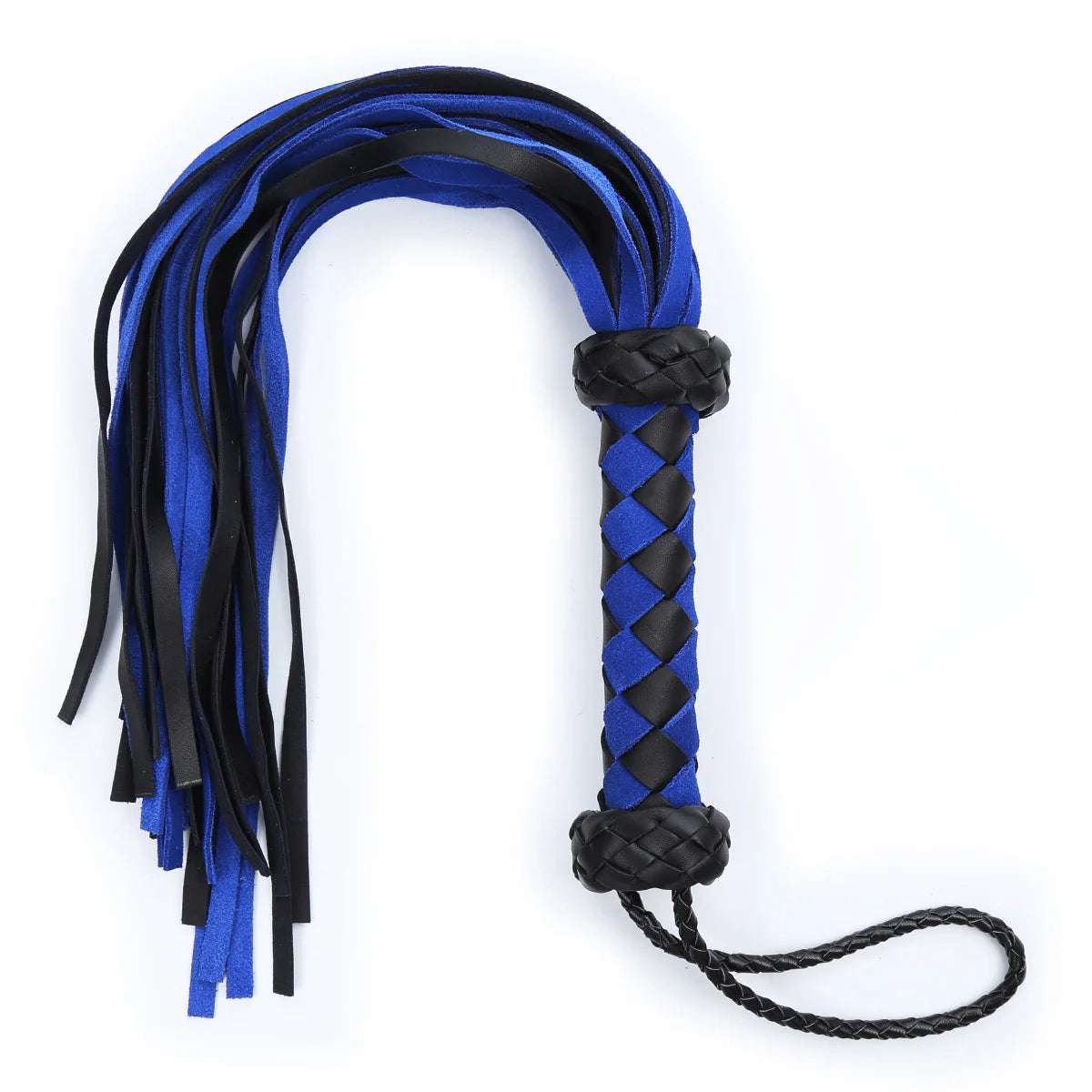
The Suede BDSM Flogger ($39.90) delivers broad, soft, minimal-sting contact by design — a natural choice when a "yellow, too much" signal comes through and an immediate, reliable step down in intensity is needed. The Black & Gold Leather Riding Crop ($49.00), rated 6/10 on both sting and thud, sits at a noticeably sharper point on the spectrum — useful when the signal goes the other direction and more sensation is genuinely wanted. Having both within reach means a Top doesn't have to try to soften or sharpen their swing with the same implement under real-time pressure, which is a harder skill than simply reaching for a tool built for the intensity level actually being requested.
Reading Nonverbal Cues Alongside the Signal System
A formal signal system works best alongside ongoing attention to body language, since some people find it genuinely difficult to voice a yellow signal even when they know the system exists and have agreed to use it.
Tensing away from contact, a change in breathing rhythm, or a shift in vocal tone can all suggest a mismatch even before a formal signal is given, and a Top who stays attentive to these cues throughout the scene can sometimes catch a needed adjustment before it needs to be verbalized at all. This doesn't replace the signal system — it supplements it, catching the gap for partners who might hesitate to speak up even with permission already firmly established. Building this kind of attentiveness takes practice and genuinely benefits from the couple discussing, afterward, which cues actually correlated with a real need for adjustment versus which ones didn't mean much at all in that particular context.
Non-Verbal Signals When Words Feel Disruptive
For scenes where verbal communication might be difficult or disruptive to the mood, a pre-agreed non-verbal signal system handles the same job without breaking immersion.
A hand squeeze of a specific count, a dropped object, or even an agreed sound can all work as a non-verbal version of the yellow signal — whatever the couple settles on in advance. Some experienced couples develop an entire wordless vocabulary over time: a touch on the shoulder meaning "pause," a particular sound meaning "more," built up gradually through repeated practice rather than invented from scratch in a single conversation. Starting simple — one clear signal for "adjust" and one for "stop" — is a more realistic starting point than trying to build an elaborate system before you've tested whether the basic version works for you.
What to Do When the Gap Is Large
When the mismatch is significant rather than a minor calibration issue — one partner wanting dramatically more than the other's actual ceiling — that's a signal to pause and have a fuller conversation, not to keep pushing toward a compromise mid-scene.
One clear rule many experienced Dominants follow: once a scene has started, nothing gets added that wasn't already negotiated, no matter how much a partner asks for more in the moment. This isn't about being inflexible — it's about recognizing that in-the-moment requests during heightened arousal aren't always the same as a person's genuine, considered preference, and treating every such request as automatically binding can undermine the negotiation process rather than honor it. If the gap between what's being requested and what was negotiated is large, the right move is holding the previously agreed range and revisiting the larger conversation later, outside the scene, when both people can think clearly.
It can also help to have a pre-agreed phrase for exactly this situation — something that signals "I hear you, and we'll talk about this properly afterward" without needing a full explanation in the moment. This keeps the scene from grinding to an uncomfortable halt while still being honest that the request isn't something being granted right now. A Dominant holding this kind of boundary isn't being unresponsive to their partner's desires; they're protecting the integrity of the negotiation process itself, which ultimately benefits both people by keeping trust in the system intact for future scenes together.
The Post-Scene Conversation That Prevents Repeat Mismatches
A brief debrief after the scene — not during aftercare's most vulnerable window, but sometime before the next session — is where recurring mismatches actually get resolved.
Post-scene discussions allow partners to evaluate what worked, what didn't, and how to improve future sessions, which is exactly the right venue for addressing a recurring intensity mismatch rather than trying to solve it from scratch every single time it comes up mid-scene. If the same gap keeps appearing — one partner consistently wanting more than the other consistently offers — that's useful, specific information to negotiate around directly, rather than something to keep patching over with in-the-moment signals alone.
A useful format for this conversation is asking each partner to independently name where they felt the scene landed on their own personal scale, before comparing notes. Sometimes this reveals the gap was smaller than it felt in the moment; sometimes it confirms a genuine, recurring difference worth building a longer-term plan around, such as regularly alternating who gets more of what they want across sessions, or deliberately structuring future scenes with a lighter opening phase for one partner's comfort followed by a more intense closing phase for the other's.
Calibration Signal Table
| Signal | Meaning | Action |
|---|---|---|
| Green | Current intensity is working | Continue as is |
| Yellow (up) | Wants more intensity | Build gradually or switch to a sharper implement |
| Yellow (down) | Wants less intensity | Ease off or switch to a softer implement |
| Red | Needs to stop entirely | Stop immediately, move to aftercare |
FAQ
Common questions about handling mismatched intensity expectations.
Does wanting different intensity levels mean we're not compatible?
No. Intensity preferences vary session to session for almost everyone, and a mismatch on a given night reflects normal variation, not a deeper incompatibility between partners.
Should we use "yellow" even for small adjustments?
Yes — treating yellow as a frequent, low-stakes signal rather than a rare intervention is what makes real-time calibration actually work, instead of saving it only for larger concerns.
What if my partner asks for more in the moment but we didn't negotiate that far?
Holding the previously agreed range is the safer default, since in-the-moment requests during heightened arousal don't always reflect someone's fully considered preference. Revisit it later, outside the scene.
Is it normal to need to switch implements mid-scene?
Very common, and often the most practical way to adjust intensity quickly without asking a Top to alter their technique under pressure. Keeping two or three implements with different profiles within reach makes this easier.
What if we keep having the same mismatch every time?
That's worth a dedicated conversation outside of scene space, since a recurring pattern is more useful to negotiate directly than to keep managing with real-time signals session after session.
Can non-verbal signals really replace talking during a scene?
For many couples, yes, especially once a shared signal vocabulary has been practiced and tested. Start with one clear signal for "adjust" and one for "stop" before building anything more elaborate.
What if one of us is naturally more vocal about preferences than the other?
This is common and worth naming directly during negotiation, since a quieter partner's silence can otherwise get mistaken for satisfaction rather than reluctance to speak up. Building in a regular, casual check-in — even a simple "still good?" every so often — helps close that gap without putting the entire burden on the quieter partner to initiate every single adjustment themselves.
Does using a signal system make the scene feel less spontaneous?
Most couples find the opposite is true after some practice — having a reliable system in place actually allows for more spontaneity and intensity, since both partners trust that a genuine issue will be caught and addressed quickly rather than needing to hold back out of uncertainty.
Should the Dominant or the receiving partner initiate the calibration conversation?
Either partner can and should feel equally responsible for raising a mismatch. Framing this as a shared responsibility from the start, rather than something only the receiving partner is expected to flag, tends to produce a more balanced and honest dynamic overall for both people involved.
Final Thoughts: Build the System Before You Need It
A pre-agreed range, a simple real-time signal, and two implements with genuinely different intensity profiles handle most mismatches without ever needing to pause the scene for a full conversation.
Negotiate a floor and ceiling rather than a fixed number, keep both the Suede BDSM Flogger and the Black & Gold Leather Riding Crop within reach for quick adjustments, and save the deeper conversation for after the scene if a mismatch keeps


