
How to Choose the Right Riding Crop for Your Skill Level

"Beginner" and "advanced" on a riding crop product page aren't marketing filler — they describe something specific and measurable: how much margin for error the tool gives you, how quickly sensation builds, and how much technique is required before the crop behaves predictably. Buying the wrong skill level isn't dangerous in a dramatic sense, but it does mean either an underwhelming first experience or a session that escalates faster than either partner expected. If you haven't compared crops to other impact tools yet, start with the Impact Play Toys 101 guide, and for material fundamentals, see The Complete Guide to Riding Crops. This guide is entirely about matching a crop's actual skill-level rating to where you honestly are right now.
Riding crop skill level is determined by tip material, tip thickness, shaft flex, and total reach — not by price or appearance — and matching these factors honestly to your experience prevents both a disappointing first session and an overwhelming one.
🔽 Quick Navigation
- 📌 Before You Shop by Skill Level
- 📌 What "Skill Level" Actually Measures
- 📌 Beginner Crops: What to Look For
- 📌 Intermediate Crops: What Changes
- 📌 Advanced Crops: What Changes
- 📌 Full Skill-Level Comparison Table
- 📌 Four Honest Questions to Self-Assess
- 📌 Common Mistakes When Matching Skill to Crop
- 📌 Real Experience: Buying Below Your Instinct
- ❓ FAQ
- 🧭 Final Thoughts: Skill Level Is a Tool, Not a Label
Before You Shop by Skill Level
A crop's skill-level rating is a practical safety and satisfaction signal, not a judgment about experience or identity — treat it as a spec, the same way you'd read weight or length.
Every crop in this guide should only ever contact the buttocks and outer thighs. Never target the spine, kidneys, lower back, joints, neck, or any injured or numb area, regardless of skill level. Agree on a stop system before your first strike with any new crop, and understand that "beginner-rated" does not mean risk-free — it means the tool is more forgiving of imperfect technique, not that technique stops mattering entirely.
What "Skill Level" Actually Measures
Four physical factors determine a crop's skill-level rating, and understanding them lets you evaluate any crop yourself instead of relying purely on a label.
| Factor | What It Affects | Beginner-Friendly Range | Advanced Range |
|---|---|---|---|
| Tip material | How fast sensation builds and fades | Silicone, softer leather | Thick genuine leather, rigid materials |
| Tip thickness | Mass and depth of contact | Thin, light tips | Thick tips (3mm+) |
| Shaft flex | How much technique the swing requires | Stiffer, more predictable shafts | Highly flexible, whip-style shafts |
| Total reach | How much wind-up and control margin exists | Shorter overall length | Longer shafts requiring more arc control |
A crop rated "beginner-to-advanced" on a single product listing, like a versatile thick-leather design, usually means the base sensation is scalable — light taps stay gentle, while committed strikes reach real intensity. A crop rated strictly "intermediate-to-advanced" usually means even its lightest reasonable use still demands more precision than a true beginner tool.
Beginner Crops: What to Look For
A genuinely beginner-friendly crop combines a soft or flexible tip, minimal tip thickness, and a shorter overall length that keeps the margin for error wide.
The Shaped Silicone Riding Crop ($25.90) checks every one of these boxes. Its flexible silicone tip — offered in heart, hand, foot, or butterfly shapes — flexes and rebounds quickly rather than transferring force directly, which is exactly why SexPaddle rates its Impact Index at a light 3/10 sting and 2/10 thud. At a compact 18.5 in / 47 cm with a weighted metal handle, it stays easy to control even with imperfect wrist mechanics. SexPaddle explicitly positions this as beginner-to-intermediate, and the shaped tip options add a playful, low-pressure entry point rather than a serious discipline tool.

If you're choosing a first crop specifically to build calibration experience before moving to leather, a silicone-tipped design like this one is close to an ideal starting point: forgiving enough to make mistakes safely, while still teaching real wrist mechanics and target-zone discipline.
Intermediate Crops: What Changes
Moving into intermediate territory usually means either a thicker leather tip, a longer shaft, or both — sensation becomes more substantial without necessarily becoming unmanageable.
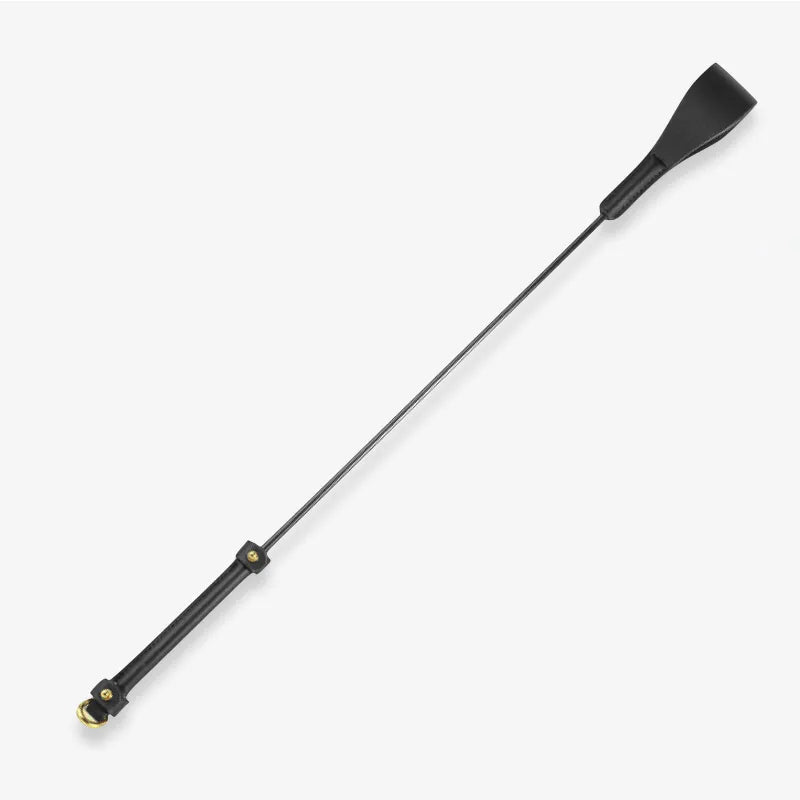
The Black and Gold Leather Riding Crop ($49.00) sits in this scalable middle ground. Its 3.5mm thick genuine leather tip carries noticeably more mass than a thin faux leather head, producing a balanced 6/10 sting and 6/10 thud — substantial, but not extreme. At 24.4 in / 62 cm with gold-tone hardware and a compact 5.9 in handle, SexPaddle rates it beginner-to-advanced specifically because the thick leather tip scales well: light calibration taps stay manageable, while more committed strikes reach genuinely serious feedback. This scalability is what makes it a smart choice for someone who has outgrown a pure beginner tool but isn't ready for a fully advanced, whip-style crop.
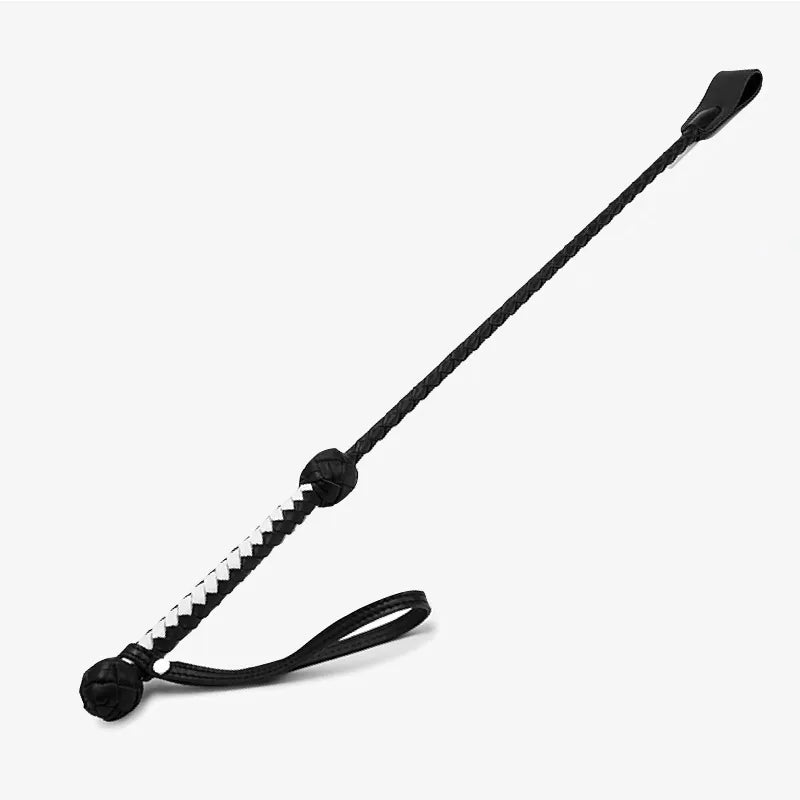
The White-Gold Snakeskin Leather Riding Crop ($129.00) is a similarly accessible intermediate pick, with a compact 18.9 in / 48 cm length and a beginner-to-intermediate rating despite its premium, fully hand-woven leather construction — proof that price and skill-level rating don't always move together.
Advanced Crops: What Changes
Advanced crops typically combine a flexible, whip-style shaft with a longer total reach, which means the tool builds real tip speed through the swing rather than relying on the giver's arm alone.
The Dual-Layer Cowhide Riding Crop ($69.00) illustrates this clearly. Its 28.7 in total length includes a 16.5 in flexible whip-style section that flexes through the swing before the compact dual-layer cowhide tip makes contact, producing a substantial 7/10 sting and 7/10 thud. SexPaddle rates this intermediate-to-advanced because the flexible shaft introduces genuine wrap-around risk that a rigid or shorter crop doesn't have — the tip's exact landing point depends on arc control that takes real practice to develop. The 8.7 in handle with a 6.7 in spiral grip lets an experienced user choke up for shorter, controlled taps or extend for heavier full-reach strikes, but that flexibility is a skill requirement, not a convenience for a first-time user.
Advanced crops reward exactly the kind of practiced, deliberate technique that beginner tools are specifically designed to forgive — which is precisely why the sensation ceiling is higher, and precisely why the margin for error is lower.
Full Skill-Level Comparison Table
Laying all four featured crops side by side makes the skill-level progression concrete rather than abstract.
| Crop | Price | Tip Material | Impact Index | Skill Level |
|---|---|---|---|---|
| Shaped Silicone Riding Crop | $25.90 | Silicone (shaped) | 3/10 sting, 2/10 thud | Beginner to intermediate |
| White-Gold Snakeskin Leather Riding Crop | $129.00 | Hand-woven leather | Moderate, compact reach | Beginner to intermediate |
| Black and Gold Leather Riding Crop | $49.00 | 3.5mm thick genuine leather | 6/10 sting, 6/10 thud | Beginner to advanced (scalable) |
| Dual-Layer Cowhide Riding Crop | $69.00 | Dual-layer cowhide | 7/10 sting, 7/10 thud | Intermediate to advanced |
Four Honest Questions to Self-Assess
Answering these honestly does more to predict which crop you'll actually enjoy than any product description alone.
| Question | If "not much" or "no" | If "yes, comfortably" |
|---|---|---|
| Have you used any impact tool before? | Start with silicone or thin leather | A thicker leather tip is reasonable |
| Can you consistently place light taps on target? | Practice with a forgiving tip first | A flexible whip-style shaft is manageable |
| Do you know your sting-vs-thud preference? | A scalable, balanced crop is a safer bet | Choose a crop that leans toward your known preference |
| Have you practiced swing arc without a partner? | Stick to shorter, rigid-feeling crops | A longer, flexible-shaft crop is appropriate |
Common Mistakes When Matching Skill to Crop
Most crop-related disappointment traces back to one of a few predictable mismatches between buyer and product.
| Mistake | Why It Happens | Better Approach |
|---|---|---|
| Buying based on appearance alone | Decorative crops can look beginner-friendly regardless of actual tip material | Always check the stated Impact Index and skill level |
| Assuming higher price means higher skill requirement | Premium materials and craftsmanship don't always mean higher intensity | Compare skill-level ratings independently of price |
| Skipping calibration with a new crop | Assuming experience with one crop transfers directly to a different tip material | Start every new crop with light calibration taps regardless of past experience |
| Choosing a long flexible-shaft crop first | Longer often looks more "serious" or impressive | Match shaft flex to actual arc-control experience, not visual appeal |
Real Experience: Buying Below Your Instinct
Choosing a crop rated slightly below what feels appropriate on paper often produces a better first experience than buying at or above your actual skill level.
In a composite scenario based on common buyer questions, Priyanka and Alex were shopping for their first crop and were drawn immediately to the Dual-Layer Cowhide Riding Crop's dramatic, whip-style profile — longer, more serious-looking, and clearly built for experienced users. After reading through the skill-level fundamentals, they made a deliberate choice to start instead with the Shaped Silicone Riding Crop, reasoning that neither of them had any prior crop experience.
The first few sessions with the silicone crop revealed exactly the calibration gaps the skill-level system is designed to catch: Alex's aim drifted more than expected at faster wrist speeds, and Priyanka's sense of "light" contact was initially firmer than intended. Because the silicone tip forgave both issues, they built real technique before any of it mattered on a less forgiving tool. Three months later, they added the Black and Gold Leather Riding Crop as a scalable next step, and eventually the Dual-Layer Cowhide crop once arc control with a flexible shaft was no longer a variable they were still learning. Their takeaway: buying "below" your instinct on skill level almost always produces a better arc of experience than buying at the ceiling of what you think you can handle.
FAQ
These answers cover the most common questions about matching riding crop skill level to experience.
What determines a riding crop's skill level rating?
Four factors: tip material, tip thickness, shaft flex, and total reach. Softer tips, thinner materials, stiffer shafts, and shorter lengths all point toward beginner-friendly; the opposite combination points toward advanced.
Always check these specifics rather than relying on price or appearance alone.
Is a more expensive crop always more advanced?
No. Price often reflects material quality and craftsmanship rather than intensity — a $129 premium leather crop can still be rated beginner-to-intermediate, while a $25 crop can be positioned for more experienced users depending on its tip and shaft design.
Check the stated Impact Index and skill level independently of price.
Can I use a beginner crop and just hit harder for more intensity?
To some extent, yes, but a beginner crop's tip material and shaft design place a natural ceiling on how sharp or heavy the sensation can get.
If you consistently want more than a beginner crop can deliver even at full effort, that's a sign to move toward an intermediate design rather than forcing more force from the same tool.
How do I know if I'm ready for a flexible whip-style crop?
Comfort with consistent, precise placement using a shorter or more rigid crop is the main prerequisite. Practicing your swing arc alone, without a partner, is a reasonable way to test readiness before committing.
If your aim drifts noticeably at faster speeds, a flexible shaft will amplify that inconsistency.
Should both partners have the same skill-level comfort?
Not necessarily the giver and receiver specifically, but both should agree on which crop is appropriate for the current session and understand why.
It's common for the giver's technique confidence to lag behind their theoretical understanding — start conservatively regardless of how ready you feel.
What if I buy a crop and it turns out to be too advanced for me?
Use it more conservatively than its rated skill level suggests — very light, infrequent contact while you build technique — or set it aside temporarily in favor of a more forgiving tool.
There's no requirement to use every purchased tool at full intended intensity right away.
Does a longer crop always mean higher skill level?
Generally, longer crops with flexible shafts do require more arc control, but length alone isn't the only factor — a longer but stiffer crop can still be relatively beginner-manageable.
Evaluate shaft flex and tip material alongside length rather than length in isolation.
Can skill level change how I clean or store a crop?
Not significantly — cleaning and storage depend mainly on tip material (leather versus silicone) rather than skill-level rating.
See the material guide for specific care instructions by tip type.
Final Thoughts: Skill Level Is a Tool, Not a Label
A crop's skill-level rating exists to help you predict your actual experience, not to categorize you as a person — read it the same way you'd read weight, length, or material.
If you're new to crops, the Shaped Silicone Riding Crop offers a genuinely forgiving entry point. As you build calibration skill, the Black and Gold Leather Riding Crop scales comfortably from light to substantial. Once arc control with a flexible shaft is no longer a variable you're still learning, the Dual-Layer Cowhide Riding Crop rewards that experience with real range.
For material fundamentals across every tip type, revisit The Complete Guide to Riding Crops, and make sure your safe word system is in place using the safe word guide before your next session.


