
The Complete Guide to Riding Crops: Types, Materials & Technique

A riding crop occupies a unique space in impact play: shorter and more precise than a flogger, less demanding than a whip, and capable of a much wider sensation range than its compact size suggests. The tip does most of the work — leather, silicone, and rigid Lexan tips each transform the same wrist motion into a completely different feeling. If you haven't compared crops to other impact tools yet, see the Impact Play Toys 101 guide. This guide breaks down what makes a crop unique, how tip material changes everything, and how to choose your first one.
A riding crop's short shaft and compact tip make it the most precise close-range impact tool available, with sensation shaped almost entirely by tip material and shaft flex rather than length or weight.
🔽 Quick Navigation
- 📌 Before You Buy a Crop
- 📌 Crop vs Other Impact Tools
- 📌 Leather Tips: Structured, Lingering Sensation
- 📌 Thick Leather Tips: Weighted Precision
- 📌 Silicone Tips: Bright, Playful Snap
- 📌 How to Choose Your First Crop
- ❓ FAQ
- 🧭 Final Thoughts: The Tip Is the Whole Story
Before You Buy a Crop
A crop rewards precise, deliberate placement more than any tool except a cane, so consent, safe words, and target-zone discipline matter from the very first strike.
Crop contact should stay on the buttocks and outer thighs — never the spine, kidneys, lower back, joints, neck, or any injured or numb area. Agree on a stop system before starting, and treat the crop's compact size as a reason for more precision, not less caution — a small, fast tool can still deliver a surprisingly sharp result.
Crop vs Other Impact Tools
A crop's defining feature is its short shaft paired with a compact tip, giving it minimal wind-up and maximum control compared to longer tools.
| Tool | Wind-Up Needed | Contact Style | Precision |
|---|---|---|---|
| Riding crop | Minimal — short forearm motion | Single compact tip | Very high |
| Cane | Minimal | Full-length rod | High |
| Paddle | Low | Broad flat face | Moderate |
| Flogger | Moderate — full swing | Multiple falls | Low |
This makes a crop especially useful for close-range cueing, quick corrections, and precise, repeatable strikes rather than broad rhythmic play.
Leather Tips: Structured, Lingering Sensation
Standard leather tips deliver a balanced, structured sensation that lingers longer than the sharper, faster snap of silicone.
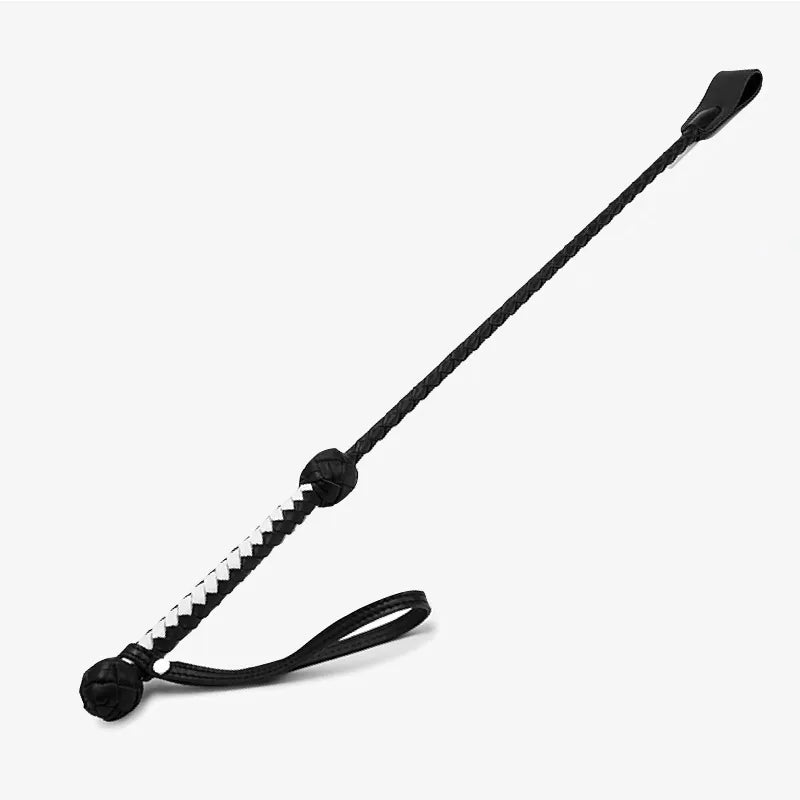
The Dual-Layer Cowhide Riding Crop shows how leather's flexible shaft builds real tip speed before the compact cowhide tip lands, producing a substantial 7/10 sting and 7/10 thud. SexPaddle rates it intermediate to advanced, since the flexible whip-style section adds real arc control demands. Leather remains the classic crop material precisely because it balances sting and thud rather than leaning entirely toward one or the other.
Thick Leather Tips: Weighted Precision
Increasing leather thickness adds real mass to the tip, shifting sensation toward a deeper, more grounded thud without losing sting entirely.
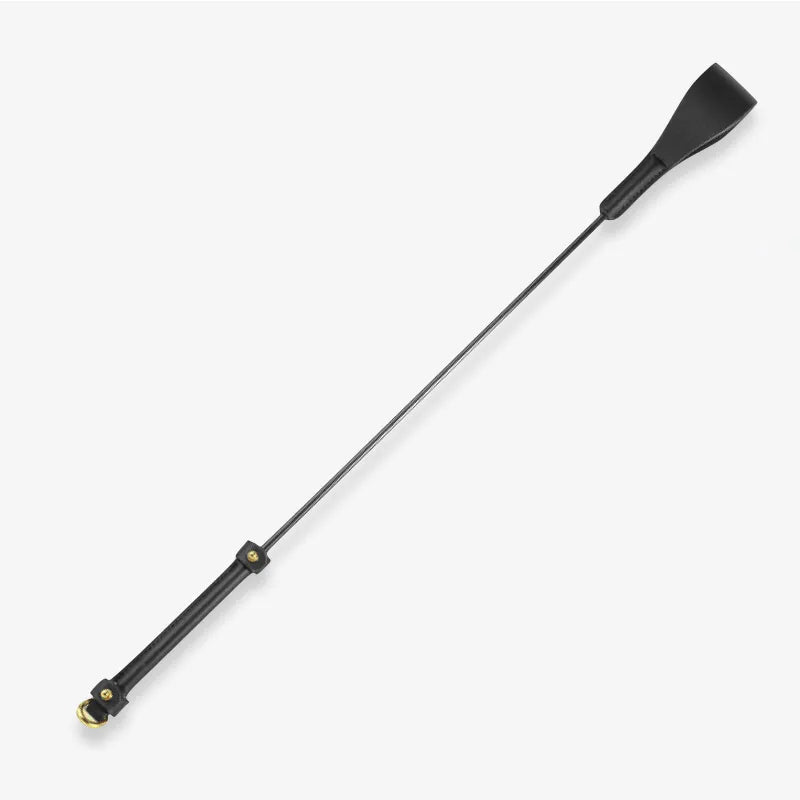
The Black and Gold Leather Riding Crop demonstrates this directly. Its 3.5mm thick genuine leather tip — noticeably thicker than a standard crop head — carries more mass than thin faux leather alternatives, producing a balanced 6/10 sting and 6/10 thud that feels deeper and more grounded than a typical crop's usual bright, surface-level bite. At 24.4 in / 62 cm with gold-tone hardware, SexPaddle positions it as beginner-to-advanced, scaling comfortably from light calibration taps to serious controlled feedback.
For an even more premium leather experience, the hand-woven White-Gold Snakeskin Leather Riding Crop ($129.00) offers a compact, polished, beginner-to-intermediate option with refined snakeskin-embossed styling.
Silicone Tips: Bright, Playful Snap
Silicone flexes and rebounds much faster than leather, producing a quick, bright snap that fades noticeably sooner than leather's lingering sting.
The Shaped Silicone Riding Crop is built entirely around this quick-snap character. Its flexible silicone tip — available in heart, hand, foot, or butterfly shapes — pairs with a weighted metal handle at a compact 18.5 in / 47 cm, producing a light 3/10 sting and 2/10 thud that SexPaddle rates beginner-to-intermediate. Because silicone is non-porous, it's also the easiest crop tip to sanitize with mild soap and water.

Silicone-tipped crops suit playful, expressive, or fantasy-themed scenes where the shaped tip communicates mood as much as it delivers sensation — this is a genuinely different experience from a serious leather discipline crop.
How to Choose Your First Crop
Match tip material to both your desired sensation and your current experience level.
| Your Situation | Recommended Starting Point |
|---|---|
| New to crops, want playful and light | Silicone-tipped crop |
| Want balanced sting and thud with real weight | Thick leather tip crop |
| Have some experience, want classic structured feel | Standard leather crop |
| Want a refined, gift-worthy piece | Premium woven leather crop |
FAQ
These answers cover common questions about choosing a riding crop.
What makes a crop different from a cane?
A crop has a flexible shaft topped with a compact tip, while a cane is typically a uniform rod along its full length. Crops build tip speed through shaft flex; canes deliver force more directly.
Crops also tend to concentrate sensation into one small point rather than a full-length line.
Is silicone or leather better for a first crop?
Silicone is generally the more forgiving starting material because it produces a lighter, quicker sensation that fades fast.
Leather offers a more traditional, structured feel with more range once you're ready for it.
Does tip thickness matter?
Yes significantly. A thicker leather tip adds mass and shifts sensation toward deeper thud, while a thin tip stays sharper and more surface-level.
Check the specific tip thickness when comparing crops, not just the material.
Can a crop hurt more than a paddle?
It depends on the specific tools being compared, but a crop's concentrated tip can feel sharper per unit of force than a paddle's broad, spread-out face.
Always check each product's Impact Index rather than assuming based on tool type alone.
Are crops good for beginners?
Some are. Silicone-tipped and lighter leather crops with lower Impact Index ratings suit beginners well, while thick leather or long-reach crops are better suited to experienced users.
Check the stated skill level on each specific product.
How do I clean a leather versus silicone crop tip?
Leather tips should be wiped dry and conditioned periodically; never soak them.
Silicone tips can be washed with mild soap and water, making them the easiest material to sanitize.
Final Thoughts: The Tip Is the Whole Story
With a crop, tip material and thickness explain almost the entire sensation profile — pay more attention to the tip than to shaft length or overall size.
For a playful, forgiving start, the Shaped Silicone Riding Crop is a strong first pick. For balanced, weighted sensation, the Black and Gold Leather Riding Crop scales from gentle to serious. For classic structured leather, the Dual-Layer Cowhide Riding Crop delivers real range once you're ready for it.
For the full picture across every impact toy type, revisit the Impact Play Toys 101 guide, and make sure your safe word system is in place using the safe word guide before your next session.


