
Beginner vs Advanced Impact Toys: What to Buy First

Once you've tried a few tools, a natural question comes up: what actually separates a "beginner" toy from an "advanced" one, and when are you ready to move up? It's rarely about price or how dramatic something looks. It comes down to how forgiving the tool is of imperfect technique, and how much control it demands from the user. If you haven't compared tool types yet, start with the Impact Play Toys 101 guide. This guide focuses specifically on what changes between a beginner and an advanced impact toy.
Beginner impact toys are forgiving of imperfect aim and calibrated toward gentler sensation, while advanced tools demand more precise technique and deliver a wider, more intense sensation range.
🔽 Quick Navigation
- 📌 Before You Shop by Skill Level
- 📌 Beginner vs Advanced at a Glance
- 📌 Beginner Picks: Forgiving and Predictable
- 📌 Advanced Picks: Precise and Intense
- 📌 How to Know When You're Ready to Progress
- 📌 Real Experience: Progressing From Beginner to Advanced Tools
- ❓ FAQ
- 🧭 Final Thoughts: Progress at Your Own Pace
Before You Shop by Skill Level
Skill-level ratings describe how forgiving a tool is, not how "serious" or committed you need to be to use it.
Every tool in this guide should only be used on the buttocks and outer thighs — never the spine, kidneys, lower back, joints, neck, or any injured or numb area — regardless of its skill-level rating. Agree on a stop system before starting, and remember that an "advanced" rating means a tool requires more precision and lighter starting force, not that it's reserved for some other category of person.
Beginner vs Advanced at a Glance
The core difference is forgiveness: beginner tools tolerate imperfect technique, while advanced tools reward — and require — more precise control.
| Factor | Beginner Tools | Advanced Tools |
|---|---|---|
| Aim tolerance | Forgiving of imperfect placement | Rewards precise, deliberate placement |
| Sensation range | Narrower, more predictable | Wider, capable of sharper peaks |
| Practice needed | Minimal — usable right away | Solo practice often recommended |
| Featured picks | Classic Elegant Leather Flogger, Eight-Rod Rattan Cane | Dual-Layer Cowhide Crop, Knot-Braided Jute Rope Whip |
Beginner Picks: Forgiving and Predictable
The best beginner tools spread sensation broadly or disperse it across multiple points, which softens the consequence of imperfect aim.
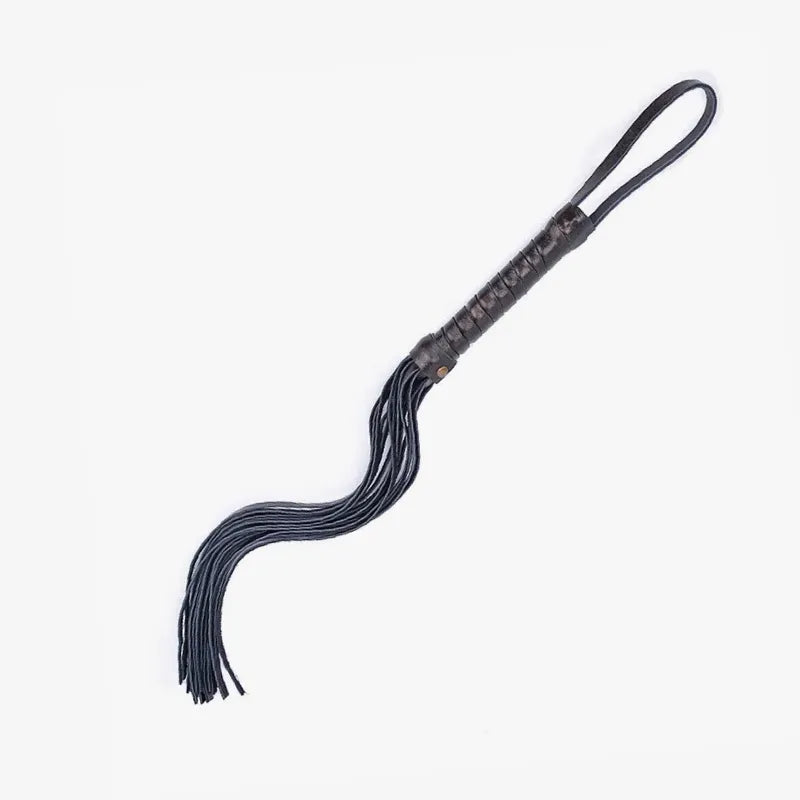
The Classic Elegant Leather BDSM Flogger ($59.00) is a strong beginner pick because its 3/10 sting and 6/10 thud profile leans deep and warm rather than sharp, and its multiple falls spread contact across an area rather than concentrating it. The non-slip handle also helps maintain steady control through repeated motion, which matters more for a new user still building rhythm.
The Eight-Rod Rattan Discipline Cane ($27.90) shows that even a cane — a category often assumed to be advanced by default — can be beginner-friendly when the design disperses contact. Its eight-rod bundle spreads sting across several points rather than one solid line, at just 100 g for quick, light, low-commitment strikes. Both picks share the same underlying trait: a built-in margin for error while a new user is still calibrating force and reading feedback.
Advanced Picks: Precise and Intense
Advanced tools generally either concentrate sensation into a smaller area or remove structural forgiveness like a rigid handle, both of which raise the skill floor.
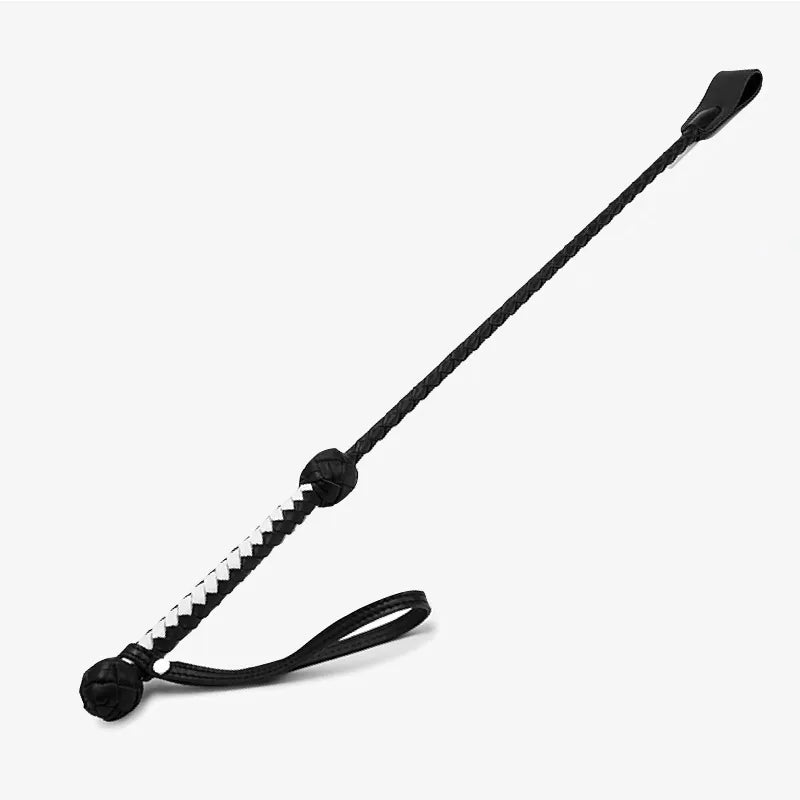
The Dual-Layer Cowhide Riding Crop ($69.00) illustrates the first pattern. Its flexible 16.5 in shaft builds real tip speed before a compact dual-layer cowhide tip lands, producing a 7/10 sting and 7/10 thud — intermediate-to-advanced specifically because that flexible shaft adds wrap-around risk and requires practiced arc control that a rigid tool does not.
The Knot-Braided Jute Rope Whip ($49.00) illustrates the second pattern. With no rigid handle at all, its 47.24 in jute rope construction depends entirely on the user's timing to build and control pendulum momentum, landing a heavy 6/10 sting and 8/10 thud. SexPaddle rates this squarely advanced, and it should only be approached after solo practice and real experience with handle-based tools.
How to Know When You're Ready to Progress
Readiness is about comfort with the fundamentals, not time elapsed since your first purchase.
| Sign | What It Means |
|---|---|
| You can predict how your current tool will feel | You've built a reliable calibration baseline |
| You describe sensation with specific vocabulary | "Sharper," "deeper," "more concentrated" instead of just "harder" |
| Your aim is consistent even at speed | You can place strikes reliably without slowing down excessively |
| You're curious about a specific new sensation | A clear reason to progress, rather than boredom or pressure |
Real Experience: Progressing From Beginner to Advanced Tools
Most people who progress smoothly do so gradually, adding one advanced tool at a time rather than replacing their entire beginner collection at once.
In a composite scenario based on common upgrade questions, Nadia had used the Classic Elegant Leather BDSM Flogger and Eight-Rod Rattan Discipline Cane comfortably for about four months and felt confident describing sensation with real specificity — sting versus thud, sharp versus dispersed. Curious about something with a wider range, Nadia's partner suggested trying the Dual-Layer Cowhide Riding Crop.
They approached it deliberately: light taps first, checking in after every few contacts, treating the crop's flexible shaft as a genuinely new skill rather than assuming flogger and cane experience would transfer directly. It took a few sessions before Nadia's partner felt confident with the crop's arc, but the calibration skills built with the beginner tools made the learning curve noticeably shorter than starting from zero. The Knot-Braided Jute Rope Whip stayed on their wishlist for later, once the crop felt fully comfortable. Their takeaway: progressing one tool at a time, with patience for the new learning curve each one requires, felt far better than trying to jump straight to the most advanced option.
FAQ
These answers cover common questions about choosing between beginner and advanced impact toys.
What makes a toy "advanced" instead of "beginner"?
Advanced tools generally either concentrate sensation into a smaller area or lack a rigid handle, both of which require more precise technique than a forgiving beginner design.
It's about required skill, not intensity alone.
How long should I use beginner tools before progressing?
There's no fixed timeline. Progress when you can consistently predict your current tool's sensation and have specific curiosity about something new.
Some people stay with beginner tools indefinitely and are completely satisfied.
Can an advanced tool ever feel gentle?
Yes, with very light, controlled use, but the skill requirement remains the same regardless of how gently you start.
Advanced ratings reflect the precision needed, not a mandatory intensity level.
Should I buy an advanced tool as a gift for a beginner?
Generally not recommended as a first gift. A beginner-rated tool lets a new user build confidence before tackling something that demands more precise technique.
Save advanced tools for after some shared experience together.
Do I need to master every beginner tool before progressing?
No. You can progress once you feel confident with the fundamentals — consistent aim, clear sensation vocabulary, comfort with your stop system — even with just one or two beginner tools.
Progression is personal and doesn't require a checklist.
What if an advanced tool feels overwhelming?
Stop and return to a beginner tool. There's no penalty for stepping back, and revisiting fundamentals is a normal part of building comfort with more demanding tools.
Try again later with lighter contact and more practice.
Final Thoughts: Progress at Your Own Pace
The line between beginner and advanced is about forgiveness and required precision, not commitment level — and there's no schedule you need to follow.
Start with forgiving, predictable tools like the Classic Elegant Leather Flogger or Eight-Rod Rattan Discipline Cane. When you're ready for a wider sensation range and have the patience for a new learning curve, the Dual-Layer Cowhide Riding Crop and Knot-Braided Jute Rope Whip offer that next step.
For the full picture across every impact toy type, revisit the Impact Play Toys 101 guide, and make sure your safe word system is in place using the safe word guide before your next session.


