
Leather Grades Explained: Full Grain, Top Grain, Genuine and Bonded — What You're Actually Paying For

"Genuine leather" is technically true of almost every leather product you'll ever see listed for sale — and that's exactly the problem. The term covers everything from the densest, most durable hide available down to scraps of leather fiber glued together and pressed flat. If you've ever wondered why one leather paddle costs $24.90 and another costs $59.00 despite both saying "leather" on the label, the answer isn't marketing. It's grade. This guide breaks down what full-grain, genuine, and faux/PU leather actually mean, using real products so you can see the difference rather than just read about it.
Leather grade is determined by how much of the hide's original surface remains intact — full-grain keeps the entire natural surface for maximum durability and character, genuine leather is real hide that's been sanded or corrected, and faux/PU leather is synthetic material designed to mimic leather's look without using hide at all.
🔽 Quick Navigation
- 📌 Why Leather Grading Exists
- 📌 Full-Grain Leather: The Uncut Original
- 📌 Genuine Leather: Real Hide, Refined
- 📌 Faux and PU Leather: Synthetic by Design
- 📌 Side-by-Side Comparison Table
- 📌 How Grade Affects Sensation, Not Just Durability
- 📌 How to Spot the Grade When a Listing Doesn't Say
- 📌 Real Experience: Paying Attention to Grade for the First Time
- ❓ FAQ
- 🧭 Final Thoughts: Grade Tells You What You're Actually Buying
Why Leather Grading Exists
A cow hide isn't uniform — different layers and different sections have different density, and grading exists to describe exactly which part of the hide, and how much processing, went into a specific piece of leather.
A hide is essentially a stack of layers. The topmost layer, closest to the animal's outer surface, is the densest, most fiber-rich, and most durable. Deeper layers are progressively looser and weaker. Grading terminology tells you which layer you're getting and how much that layer has been altered — sanded down, corrected, split, or in the case of faux leather, skipped entirely in favor of a synthetic substitute. None of this is unique to BDSM gear; it's the same grading language used in furniture, footwear, and handbags. Once you understand the terms, you can evaluate leather quality on any product page, not just ours.
Full-Grain Leather: The Uncut Original
Full-grain leather uses the entire top layer of the hide exactly as it grew, with no sanding or surface correction — this is the densest, longest-lasting, and most expensive grade.
The Blue Crocodile Leather Spanking Paddle ($59.00) is explicitly built from full-grain genuine leather with hand-stitched construction — SexPaddle's own product specifications confirm this directly. At 400 g with an 8/10 sting and 8/10 thud rating, it's positioned for advanced users, and that intensity is partly a function of the leather itself: full-grain hide doesn't have a sanded, softened surface, so it transfers force more directly than a corrected or synthetic alternative. The iridescent crocodile embossing sits on top of genuine full-grain leather, and because the surface hasn't been sanded away, minor natural grain variation between individual pieces is expected — SexPaddle notes this explicitly as a normal characteristic, not a defect.
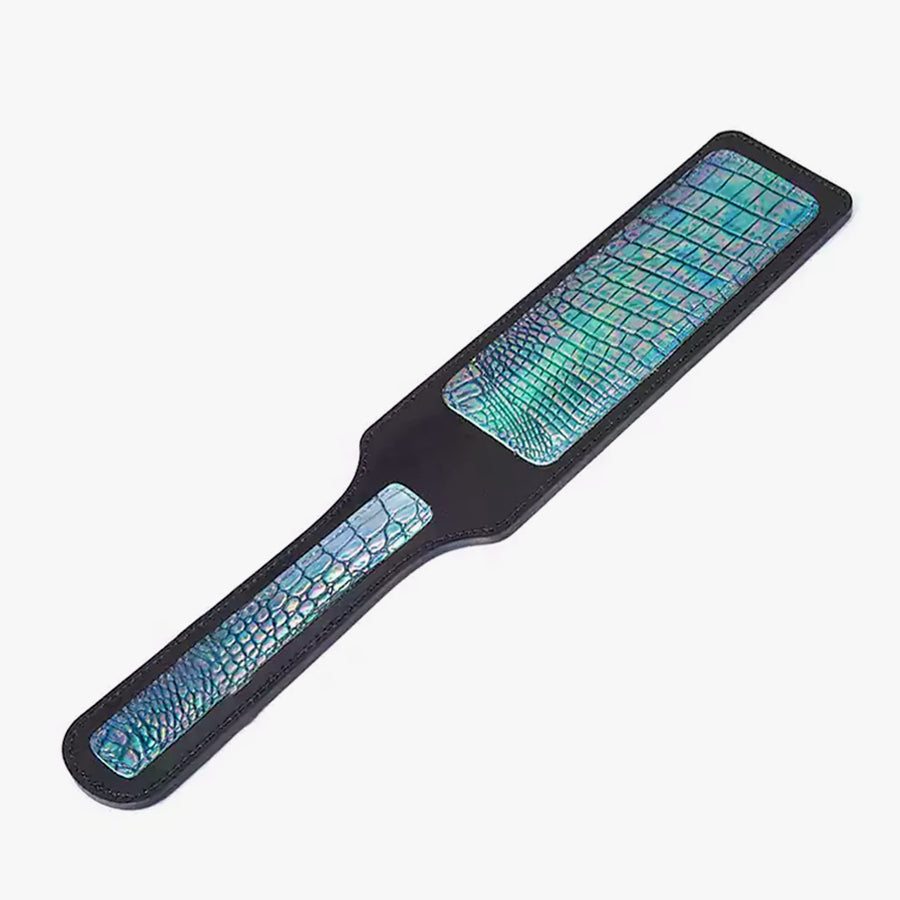
Full-grain leather also develops a patina — a gradual darkening and softening from handling and body oils — that corrected or synthetic leather cannot replicate, since that patina depends on the surface fibers being fully intact and exposed.
Genuine Leather: Real Hide, Refined
"Genuine leather" means real animal hide, but it's a broader category than full-grain — it typically includes hide that's been sanded, buffed, or embossed to correct imperfections or add a consistent pattern.
The Brown Snake Leather Round Paddle ($59.00) illustrates this category. Its genuine snakeskin-textured leather face is real hide, but the surface has been embossed with a snakeskin pattern rather than left in its natural, unaltered state — this is a common and legitimate technique that lets a manufacturer achieve a consistent decorative texture across every unit while still using authentic leather. SexPaddle rates it a 5/10 sting and 6/10 thud, noticeably softer than the full-grain crocodile paddle above, partly because embossing and light surface correction reduce some of the raw density that untouched full-grain leather retains.
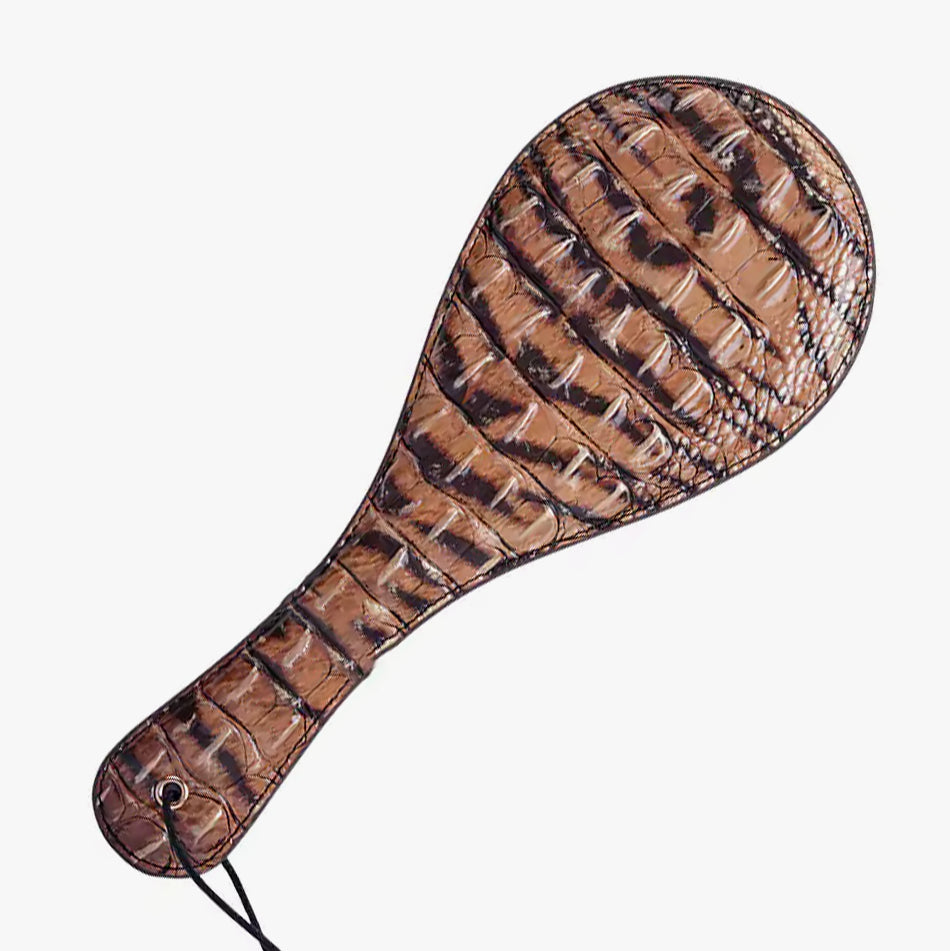
Genuine leather in this category is still real hide — it will still develop character with use and still requires the same conditioning care as full-grain — but it sits a step below full-grain in terms of raw density and the depth of natural grain variation you'll see piece to piece.
Faux and PU Leather: Synthetic by Design
Faux and PU (polyurethane) leather contain no animal hide at all — they're synthetic materials engineered to visually and texturally resemble leather at a lower cost and with easier maintenance.
The Brown Textured Square Spanking Paddle ($29.90) is explicitly listed as faux leather with soft edge binding. At 150 g with a 4/10 sting and 4/10 thud rating — noticeably gentler than either leather-grade paddle above — it demonstrates faux leather's typical profile: lighter, more flexible, and calibrated toward a more forgiving beginner-to-intermediate sensation. This isn't a flaw; it's a deliberate design choice, since faux leather's consistent, engineered texture makes it easier to calibrate a predictable, repeatable sensation than natural hide's inherent variation allows.
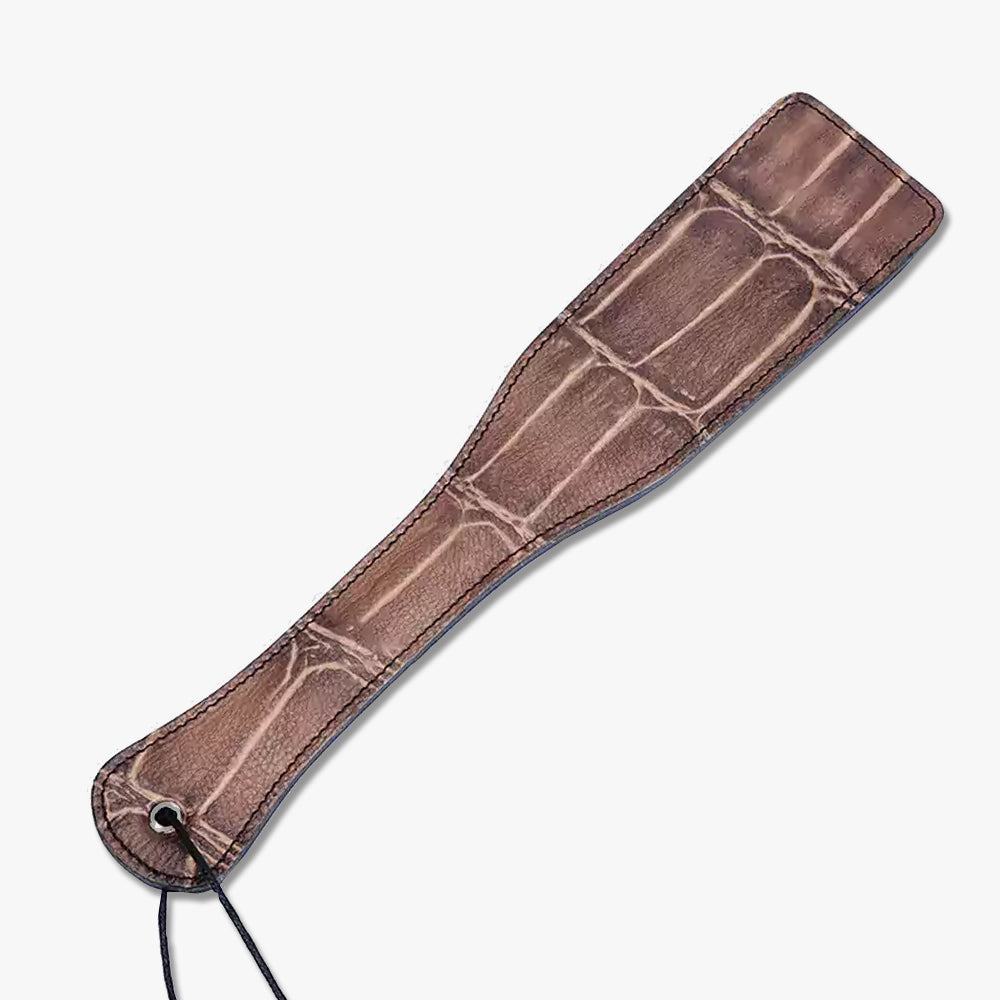
Faux and PU leather also offer a genuine practical advantage: easier cleaning. Because there's no natural hide fiber to dry out or crack, PU leather paddles can generally be wiped with mild soap and water rather than requiring the conditioning oils that genuine and full-grain leather need to stay supple.
Side-by-Side Comparison Table
Laying all three grades side by side, using their actual specs, makes the practical differences concrete rather than theoretical.
| Grade | What It Is | Feel | Care | Featured Product |
|---|---|---|---|---|
| Full-grain | Entire top hide layer, unsanded | Firm, direct, dense (8/10 sting) | Condition regularly, never soak | Blue Crocodile Leather Paddle — $59.00 |
| Genuine (embossed/corrected) | Real hide, surface refined or patterned | Moderate, balanced (5/10 sting, 6/10 thud) | Condition regularly, never soak | Brown Snake Leather Paddle — $59.00 |
| Faux / PU | Synthetic, no animal hide | Light, forgiving (4/10 sting, 4/10 thud) | Wipe with mild soap and water | Brown Textured Square Paddle — $29.90 |
How Grade Affects Sensation, Not Just Durability
Most buyers assume leather grade is purely about longevity, but it directly shapes sensation too, since density and flex are properties of the material itself.
Full-grain leather's tightly packed, unaltered fiber structure transfers force more directly, which is a real part of why the full-grain crocodile paddle above lands at 8/10 on both sting and thud. Corrected or embossed genuine leather has had some of that raw density softened during processing, producing the more moderate profile seen in the snakeskin paddle. Faux leather's engineered flexibility is calibrated by the manufacturer rather than inherited from an animal hide, which is exactly why it can be tuned toward a consistently gentler, more beginner-friendly sensation. None of this makes one grade "better" in an absolute sense — it means grade is a genuine sensation variable, not just a durability spec you can ignore if intensity matters to you.
How to Spot the Grade When a Listing Doesn't Say
Not every product description spells out the exact grade, but a few reliable signals help you infer it.
| Signal | Likely Grade |
|---|---|
| "Full-grain" or "top-grain" explicitly stated | Full-grain or top-grain leather |
| "Genuine leather" with a decorative embossed pattern | Genuine, corrected-grain leather |
| "Faux leather," "PU leather," or "vegan leather" | Synthetic, no animal hide |
| Price significantly below comparable genuine-leather items | Likely faux or PU |
| Care instructions say "wipe with soap and water" | Almost certainly synthetic — real leather is never soap-and-water washable |
That last signal is one of the most reliable: genuine and full-grain leather care instructions always center on dry wiping and periodic conditioning, never washing. If a listing says the material can be washed with mild soap and water, you're looking at a synthetic, regardless of what the product name implies.
Real Experience: Paying Attention to Grade for the First Time
Once you know what to look for, leather grade becomes an obvious factor in comparing products — most people just haven't been shown what to check before.
In a composite scenario based on common buyer questions, Adrian had purchased several "leather" paddles over time without paying close attention to grade, assuming the word "leather" meant roughly the same thing across listings. After comparing the Blue Crocodile Leather Paddle's full-grain construction against the Brown Textured Square Paddle's faux leather build side by side, the price and sensation difference finally made sense — it wasn't inconsistent pricing, it was two genuinely different materials wearing the same general word.
Going forward, Adrian started checking care instructions specifically — dry-wipe-only meant real leather, soap-and-water meant synthetic — before assuming anything about a product's durability or feel from the title alone. The takeaway was that "leather" as a label tells you almost nothing on its own; the grade behind it tells you everything that actually matters for both price and sensation.
FAQ
These answers cover the most common questions about leather grading.
Is genuine leather the same as full-grain leather?
No. "Genuine leather" is a broad category that includes real hide of varying quality, often sanded or corrected. Full-grain is a more specific, higher grade within that category — hide with its original surface left completely intact.
Full-grain is generally denser and more durable than corrected genuine leather.
Is faux leather bad quality?
Not inherently. Faux and PU leather are engineered materials with consistent, predictable properties, easier cleaning, and typically lower cost. They're a legitimate choice, especially for beginners who want a gentler, more forgiving sensation.
"Faux" describes the material's origin, not its build quality.
Why does full-grain leather cost more?
Because it uses the hide's best, most durable layer without correction or sanding, full-grain leather requires higher-quality raw hides with fewer natural imperfections, since there's no sanding process to hide flaws.
This raw material cost is the main driver of the price difference.
Can I tell the leather grade just by touching it?
With experience, often yes — full-grain leather typically feels firmer and shows more visible natural texture and grain variation, while corrected genuine leather feels more uniform, and faux leather often feels slightly more plastic or synthetic to the touch.
Checking the product's stated material and care instructions is more reliable than touch alone, though.
Does embossing mean the leather is fake?
No. Embossing is a surface treatment applied to real, genuine leather to create a consistent decorative pattern like snakeskin or crocodile texture — it doesn't mean the underlying material isn't authentic hide.
Always check whether a listing specifies "genuine leather" versus "faux leather" separately from any pattern description.
Should beginners avoid full-grain leather paddles?
Not necessarily avoid, but be aware that full-grain leather's density often correlates with a firmer, more intense sensation, as reflected in the advanced skill-level rating on our featured full-grain example.
Check the specific product's Impact Index rather than assuming based on material grade alone.
Final Thoughts: Grade Tells You What You're Actually Buying
"Leather" on its own is one of the least informative words on a product page — grade is what actually tells you about durability, sensation, care requirements, and price.
For maximum density and a firm, direct sensation, the full-grain Blue Crocodile Leather Spanking Paddle represents the top of the grading scale. For genuine hide with a refined, decorative surface, the Brown Snake Leather Round Paddle offers a balanced middle ground. For an accessible, easy-care option with a gentler sensation, the faux leather Brown Textured Square Spanking Paddle covers that need well.
For material fundamentals across every paddle type, revisit Wood vs Leather vs Silicone Paddles, and browse the full leather spanking paddles collection to compare grades directly.


