
Leather vs Lexan Riding Crops: Material Comparison

Leather and silicone sit at opposite ends of the riding crop material spectrum, and the difference isn't just about texture or price — it's about how each material builds, holds, and releases energy on contact. One flexes slowly and carries real weight; the other rebounds quickly and stays light. Neither is objectively better, but they suit genuinely different goals. If you haven't seen the broader tip-type breakdown yet, see Crop Tip Types Explained. This guide focuses specifically on leather versus silicone as materials.
Leather builds substantial, lingering sensation and ages with character over time, while silicone rebounds quickly for a lighter, faster-fading snap and is by far the easier material to clean — the right choice depends on desired intensity and maintenance tolerance, not one being universally better.
🔽 Quick Navigation
- 📌 Before You Compare Crop Materials
- 📌 Leather vs Silicone at a Glance
- 📌 Leather Tips: Substantial, Lingering Sensation
- 📌 Silicone Tips: Quick, Light, and Easy to Clean
- 📌 Care and Maintenance Compared
- 📌 Which Should You Choose?
- 📌 Real Experience: A Couple Builds a Two-Material Collection
- ❓ FAQ
- 🧭 Final Thoughts: Two Materials, Two Genuinely Different Tools
Before You Compare Crop Materials
Material changes sensation enough that switching from one to the other should be treated like trying a new tool, not a simple substitution.
Every crop, regardless of material, should only contact the glutes and upper-outer thighs, landing parallel to the muscle fibers. Never target the spine, kidneys, lower back, inner thighs, groin, or joints. If you're used to one material and trying the other for the first time, start with lighter calibration taps than your usual baseline — leather and silicone transfer the same swing motion very differently, and assuming your existing intuition carries over directly is a common source of surprise.
Leather vs Silicone at a Glance
The core difference comes down to flex speed and mass: leather flexes slowly and carries real weight, while silicone flexes and rebounds almost instantly with far less mass behind it.
| Factor | Leather | Silicone |
|---|---|---|
| Flex speed | Slower, more deliberate | Fast, springy rebound |
| Sensation | Substantial, lingering sting and thud | Light, bright, fast-fading snap |
| Cleaning | Dry wipe, periodic conditioning | Washable with mild soap and water |
| Aesthetic | Classic, structured, ages with character | Playful, shaped, consistent finish |
| Featured product | Black and Gold Leather Riding Crop — $49.00 | Shaped Silicone Riding Crop — $25.90 |
Leather Tips: Substantial, Lingering Sensation
Leather's slower flex means it holds and releases energy over a longer moment of contact, producing sensation that feels more substantial and lingers longer than a quick synthetic snap.
The Black and Gold Leather Riding Crop demonstrates this clearly. Its 3.5mm thick genuine leather tip carries real mass, producing a balanced 6/10 sting and 6/10 thud at 24.4 in / 62 cm with gold-tone hardware. SexPaddle rates it beginner-to-advanced precisely because leather's sensation scales predictably — light taps stay manageable, while committed strikes reach genuinely serious feedback. This scalability, combined with leather's natural warmth and grain variation, is part of why it remains the default material most people associate with a "real" riding crop.
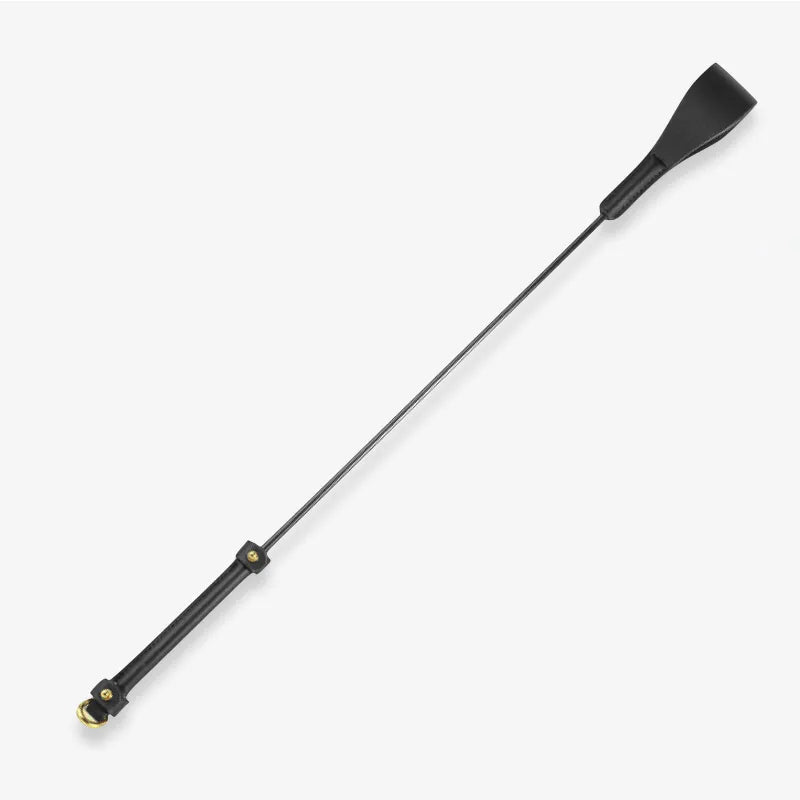
Genuine leather also develops character with continued use and proper care — small variations in grain and a gradually forming patina are normal characteristics of real hide, not flaws. For an even more premium leather experience, the fully hand-woven White-Gold Snakeskin Leather Riding Crop ($129.00) offers refined, snakeskin-embossed styling at a beginner-to-intermediate skill level.
Silicone Tips: Quick, Light, and Easy to Clean
Silicone flexes and rebounds almost instantly, producing a bright, quick snap that fades noticeably faster than leather's more lingering sensation.
The Shaped Silicone Riding Crop is built entirely around this quick-snap character. Its flexible silicone tip — available in heart, hand, foot, or butterfly shapes — pairs with a weighted metal handle at a compact 18.5 in / 47 cm, producing a light 3/10 sting and 2/10 thud that SexPaddle rates beginner-to-intermediate. Because the tip rebounds so quickly, sensation registers as a bright, momentary snap rather than the deeper, more resonant feeling leather typically produces at similar effort.

Silicone's biggest practical advantage is hygiene: because it's completely non-porous, it can be washed thoroughly with mild soap and water in a way leather never can. This makes it a genuinely appealing choice for anyone who wants the lowest-maintenance option in their collection, or who values easy sanitizing above the deeper, more traditional sensation leather provides.
Care and Maintenance Compared
Leather and silicone require almost opposite care routines, and understanding both prevents premature wear on either material.
| Material | Cleaning | Storage | Watch For |
|---|---|---|---|
| Leather | Dry wipe after each use; condition periodically | Flat or hanging, dry, away from heat | Cracking, stiffness, surface peeling |
| Silicone | Wash with mild soap and water | Dry fully before storing; keep away from sharp objects | Tearing, stickiness, loss of shape |
Never soak leather or use solvent-based cleaners on it — this strips natural oils and accelerates cracking. Silicone, by contrast, tolerates water well but should be dried fully before storage to prevent trapped moisture from affecting nearby leather-handled components, if your crop combines both materials.
Why Flex Speed Changes Everything
The physical property that separates these two materials most is flex speed — how quickly the tip bends under force and how quickly it springs back — and that single variable explains most of what people notice when comparing leather to silicone.
When a leather tip makes contact, it flexes gradually, absorbing and redistributing energy over a slightly longer window of time. This is part of why leather sensation is often described as "rounder" or "deeper" — the energy doesn't arrive all at once, and the tip's own give softens the initial edge of the strike even as it delivers substantial thud. Silicone behaves almost the opposite way: it compresses and rebounds so quickly that nearly all of the energy transfers in a short, sharp burst, which is why the resulting sensation reads as brighter and more immediate, but also fades faster once contact ends.
| Property | Leather | Silicone |
|---|---|---|
| Flex onset | Gradual | Near-instant |
| Energy release | Spread over a longer window | Concentrated in a short burst |
| Sensation persistence | Lingers after contact | Fades quickly |
| Temperature feel | Warms slightly with body heat | Stays closer to room temperature |
This is also why swapping materials mid-session can feel more jarring than swapping between two crops of the same material but different shapes. A giver accustomed to leather's gradual flex may naturally swing with slightly more follow-through than silicone needs, since silicone has already released its energy by the time a leather-trained instinct expects the "give" to continue. This is a genuine reason to treat any material switch as its own calibration period rather than a simple substitution, even when everything else about the crop looks similar.
Budget and Value Considerations
Price differences between leather and silicone crops reflect real differences in raw material cost and construction labor, not arbitrary markup.
Genuine leather requires sourcing, tanning, cutting, and stitching — all more labor- and material-intensive than molding silicone into a shape. This is part of why a comparable leather crop often costs more than a silicone one at a similar overall size and quality tier. That said, price shouldn't be the deciding factor on its own: a $25 silicone crop and a $49 leather crop can both be excellent, well-built tools that simply serve different purposes. Buyers on a tighter budget shouldn't feel that silicone is a "lesser" starting point — many experienced users keep an inexpensive silicone crop in permanent rotation specifically because of how easy it is to clean and how forgiving its lighter sensation is for quick, casual use.
Which Should You Choose?
Choose leather for substantial, traditional sensation and long-term character; choose silicone for a lighter, faster-fading snap and the easiest possible cleaning routine.
| If you want... | Choose |
|---|---|
| Deep, lingering sensation that scales with effort | Leather |
| A classic, traditional riding crop feel | Leather |
| A light, bright, quick-fading snap | Silicone |
| The easiest possible cleaning routine | Silicone |
| A playful, shaped design for lighter scenes | Silicone |
Real Experience: A Couple Builds a Two-Material Collection
Many people end up keeping one crop of each material rather than choosing definitively between them, since leather and silicone genuinely serve different moods.
In a composite scenario based on common buyer questions and real household use cases, Morgan and Dez started with the Shaped Silicone Riding Crop specifically because its light sensation and easy cleaning made it a low-pressure way to build basic crop technique together. After a few months of comfortable use, they wanted something with more substance for longer, more deliberate sessions, and added the Black and Gold Leather Riding Crop as a second piece.
The difference surprised them both — even at matched calibration effort, the leather crop's slower flex and added mass produced a noticeably deeper, more lingering sensation than the silicone tip had ever delivered. Rather than replacing the silicone crop, they kept both in rotation: the silicone for quick, casual, easy-to-clean sessions, and the leather for occasions when they wanted something more substantial and traditional. Their takeaway was that the two materials weren't really competing for the same role — each earned a specific place once they understood what made each one distinct.
FAQ
These answers cover the most common questions about leather versus silicone riding crops.
Does leather or silicone hurt more?
At matched swing effort, leather generally produces more substantial, lingering sensation because of its slower flex and greater mass, while silicone delivers a lighter, faster-fading snap.
Both can be calibrated across a range of intensities depending on the specific product's thickness and design.
Which material is easier to clean?
Silicone, by a wide margin. It's fully non-porous and can be washed with mild soap and water, while leather requires dry wiping and periodic conditioning and should never be soaked.
If easy sanitizing is your top priority, silicone is the clear choice.
Does leather really improve with age?
Yes, with proper conditioning and care, genuine leather develops a natural patina and grows more supple over time — small grain variations are a normal characteristic of real hide rather than a flaw.
This aging process doesn't apply to silicone, which stays visually consistent throughout its lifespan.
Is silicone a good material for beginners?
Often yes. Silicone's lighter, faster-fading sensation and easy cleaning make it a low-pressure way to build basic crop technique before moving to more substantial leather designs.
Check the specific product's Impact Index rather than assuming based on material alone, since ratings vary by design.
Can I use both materials in the same collection?
Absolutely, and many people do exactly this — a silicone crop for casual, lower-maintenance sessions and a leather crop for more substantial, traditional moments.
There's no requirement to choose only one material for your entire collection.
How long does a leather crop typically last with proper care?
With regular conditioning and dry storage, genuine leather crops can last for years, developing character rather than degrading.
Neglecting conditioning or exposing leather to excess moisture significantly shortens its usable life.
Why do some silicone crops come in decorative shapes?
Silicone is easy to mold into consistent, detailed shapes — hearts, animal silhouettes, and other novelty designs — in a way that's more labor-intensive to achieve with cut and stitched leather.
This is part of why silicone is common in playful, thematic crop designs.
Final Thoughts: Two Materials, Two Genuinely Different Tools
Leather and silicone aren't really in competition — one offers depth, tradition, and long-term character, while the other offers lightness, ease, and effortless hygiene, and there's a strong case for owning both eventually.
If you want substantial, lingering sensation and a crop that ages with real character, the Black and Gold Leather Riding Crop is a strong genuine leather choice. If you want a lighter touch and the easiest possible cleaning routine, the Shaped Silicone Riding Crop covers that ground well.
For the full tip-type breakdown across every design, revisit Crop Tip Types Explained, and make sure your safe word system is confirmed and in place using the safe word guide before your very next session together.


